Best eSIM for China Based on Real-World Testing


On a regular internet connection in mainland China, Google, YouTube, WhatsApp, Instagram, and many other websites and apps are not normally accessible. That means price and data allowance are only part of what matters when choosing an eSIM for China. The more important question is whether these services will actually work once you arrive.
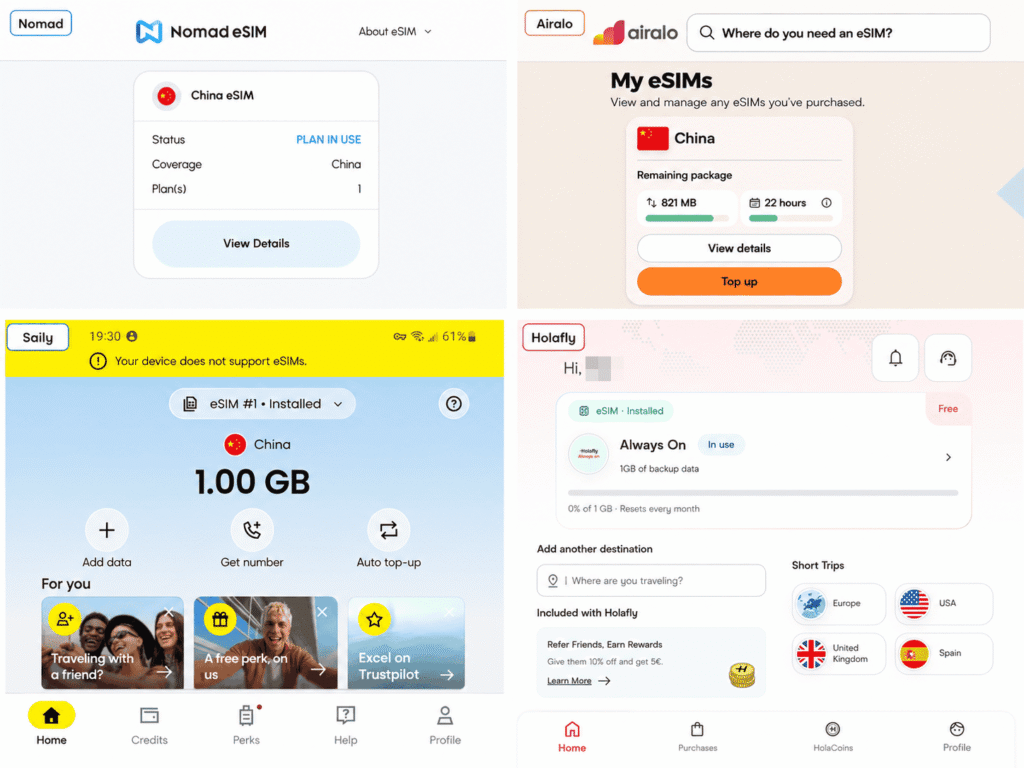
I live in Chongqing, so I can test how eSIMs actually perform in China. For this comparison, I tested four well-known travel eSIM providers, Airalo, Nomad, Holafly, and Saily, and compared their real-world performance to see which were better suited to short trips to China.
My recommendations
After two rounds of testing, Airalo and Nomad are currently the two eSIMs I recommend most.
Both performed consistently across the two rounds. Facebook, Instagram, WhatsApp, X, and YouTube all worked on both eSIMs without any connection failures, and their speeds were fairly similar.
Airalo
Nomad
How I tested the eSIMs
To keep the comparison as fair as possible, I used the same phone for all four eSIMs. Within each round, I tested them in the same place and within roughly the same time window. I turned off Wi-Fi and VPN and used only mobile data from the eSIM I was testing.
I focused on three things:
International websites and apps: I opened services such as Facebook, WhatsApp, and YouTube to see whether they worked without a separate VPN.
Video playback: I played videos on YouTube and watched for noticeable buffering or stuttering.
Speed: I used Speedtest to record download speed and latency.
Test results
Testing period: August 15 to 17, 2026
Test results are updated every 1 to 2 months.
I ran two rounds of tests. Two days after the first round, I went to a different location in Chongqing and repeated the same tests with all four eSIMs.
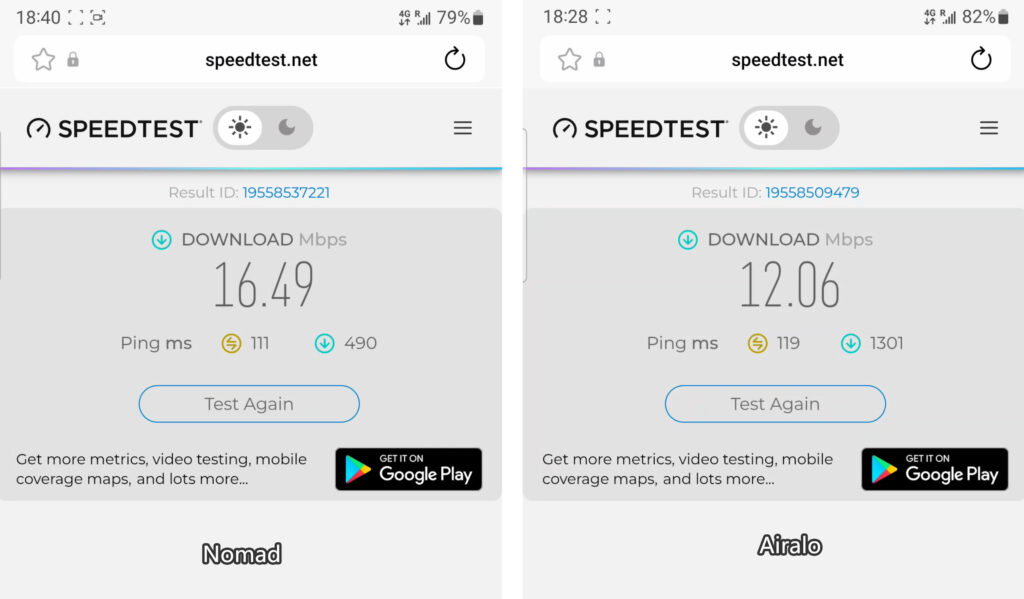
In the first round, Airalo and Nomad performed best. Facebook, Instagram, WhatsApp, X, and YouTube all worked, and I was also able to run Speedtest successfully on both. Nomad recorded a download speed of 16.49 Mbps with 111 ms latency, while Airalo reached 12.06 Mbps with 119 ms latency.
Saily worked with Facebook, Instagram, and WhatsApp, but X and YouTube would not load, and I could not complete a Speedtest.
Holafly had a more obvious problem: I could not get it online at all during the first round. I tried turning the eSIM off and back on and toggling airplane mode, but neither fixed the problem.
The first-round results are summarized below:
|
Airalo |
Nomad |
Saily |
Holafly |
|
|---|---|---|---|---|
|
|
✓ |
✓ |
✓ |
× |
|
|
✓ |
✓ |
✓ |
× |
|
|
✓ |
✓ |
✓ |
× |
|
X |
✓ |
✓ |
× |
× |
|
YouTube |
✓ |
✓ |
× |
× |
|
Download(Mbps) |
12.06 |
16.49 |
Failed |
Failed |
|
Latency(ms) |
119 |
111 |
Failed |
Failed |
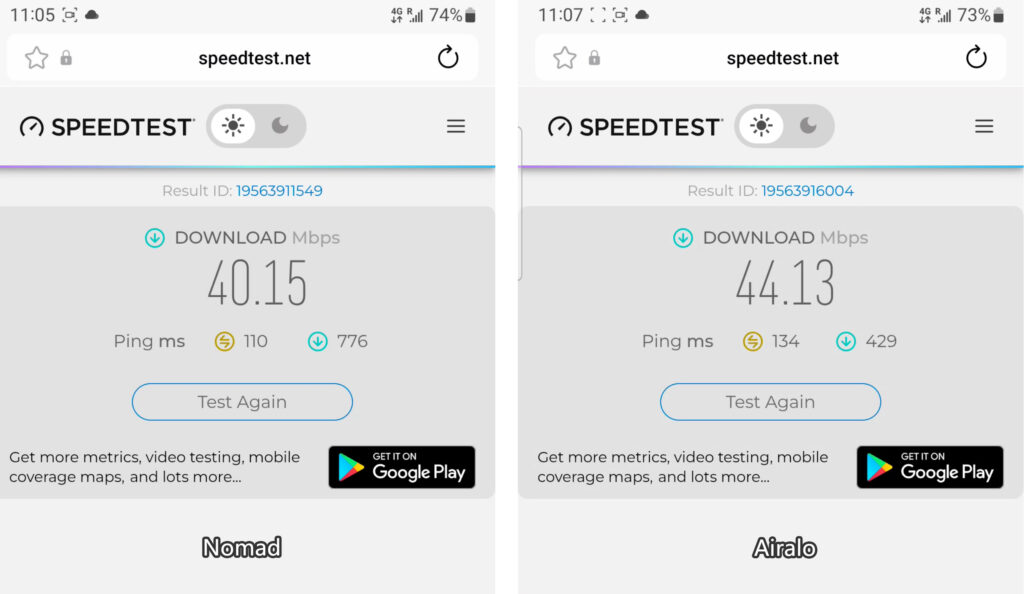
In the second round, Airalo and Nomad were just as reliable. Every website and app I tested worked. Airalo reached 44.13 Mbps, while Nomad recorded 40.15 Mbps.
Saily produced exactly the same result as before. Facebook, Instagram, and WhatsApp worked, but X and YouTube still would not load, and Speedtest failed again.
Holafly connected successfully this time, and Facebook, Instagram, WhatsApp, X, and YouTube all worked. Its download speed reached 104.32 Mbps, the fastest result in this round, while latency was 101 ms.
Holafly was connected to 5G at the time, while Airalo and Nomad were both on 4G, which may explain why its download speed was noticeably higher.
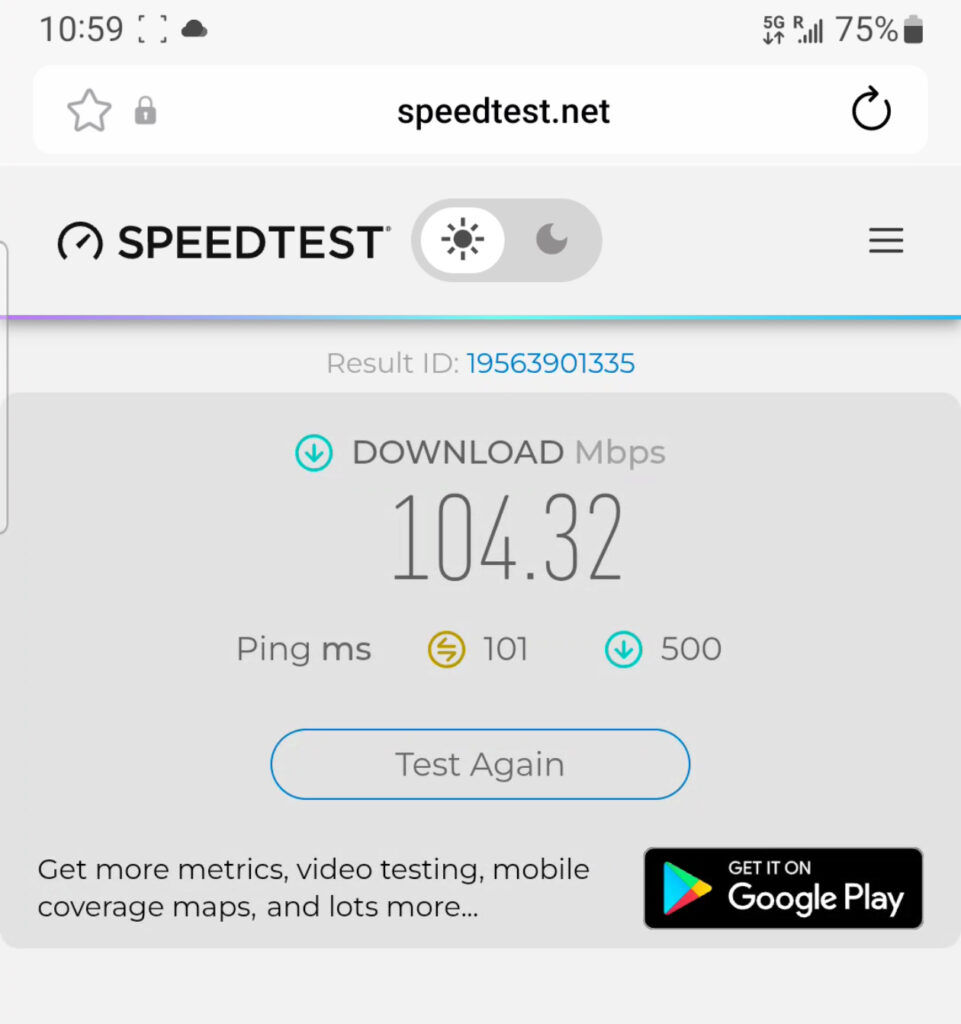
However, when I temporarily disabled Holafly and then enabled it again to check whether the connection was stable, it would no longer connect to the internet.
The second-round results are summarized below:
|
Airalo |
Nomad |
Saily |
Holafly |
|
|---|---|---|---|---|
|
|
✓ |
✓ |
✓ |
✓ |
|
|
✓ |
✓ |
✓ |
✓ |
|
|
✓ |
✓ |
✓ |
✓ |
|
X |
✓ |
✓ |
× |
✓ |
|
YouTube |
✓ |
✓ |
× |
✓ |
|
Download(Mbps) |
44.13 |
40.15 |
Failed |
104.32 |
|
Latency(ms) |
134 |
110 |
Failed |
101 |
After two rounds, the differences between the four eSIMs were fairly clear:
|
eSIM |
Performance |
|---|---|
|
Airalo |
All tested services worked in both rounds, with a stable connection |
|
Nomad |
All tested services worked in both rounds, with a stable connection |
|
Saily |
X and YouTube failed in both rounds, and Speedtest failed both times |
|
Holafly |
Fastest once connected, but had connection problems in both rounds |
I also recorded the entire testing process. The video starts with the surroundings at the first test location, followed by the actual tests for each eSIM.
Do you need a mainland Chinese phone number?
All four eSIMs I tested are primarily for mobile data. Saily is the only one that lets you add a phone number, but it gives you a US +1 number, not a mainland Chinese number.
This is typical of travel eSIMs in general. Most are mainly for data, and even when a plan includes a phone number, it usually will not be a mainland Chinese number.
For most short trips to China, however, not having a mainland Chinese phone number is not a major problem.
On a short trip, the most common situation where you will probably need a phone number is when using a ride-hailing app. DiDi allows you to register with a foreign number. If that number has international roaming enabled, the driver can call you if needed. If not, you can simply message the driver through the app.
Installation and activation
You need an internet connection to install an eSIM, so I recommend installing it before you leave for China. Some providers send the installation QR code by email, and Gmail cannot be accessed directly on a regular internet connection in mainland China. Some eSIM apps may also be affected by network restrictions, so it is best to complete the installation before departure.
Installing an eSIM in advance does not necessarily mean its validity period starts immediately. For most travel eSIMs, the validity period only begins once the eSIM connects to a network at the destination. The Airalo and Nomad China plans recommended here work this way as well.
Even so, check the activation rules for the specific plan you buy before installing it.